The Day before Mother’s Day – 2006


There was a funeral on Saturday. It was attended by dignitaries, police officers from across the country, a motorcade of cars miles long. In one of the black limousines sat two young children with their father. Their mother was in the hearse in front of them. She had been shot and killed in the line of duty trying to stop a madman from killing other police officers. As with all tragic deaths, hers was senseless and inexplicable. She was one of the golden ones who changed the lives of those who knew and loved her. It was a sad day and the community grieved for the family so brutally torn apart.

Sunday was Mother’s Day. I couldn’t get the thought of those young children off my mind as I sat with my family and celebrated my years of motherhood. Those children will, forever, have to take flowers to their mother’s grave to honor her on Mother’s Day. No early morning breakfast in bed, sticky kisses, home-made cards, or presents hand-made with too much glue and glitter will be handed to their Mom. There will be no flowers from the garden, whispered secrets, or silly jokes to share with her. From now on, Mommy will become more and more of a memory and less real by the day. The grief will follow them for a long time, and then be pushed into the back of their minds as the move on into adulthood and life.

But, deep inside, that little girl will long for her mommy to help her grow into a woman and that little boy will long for her to help him understand how to be a good man. And every year, when it is Mother’s Day, they will remember the long line of cars, the speeches, the music, and the sadness on the day they lay their Mom to rest. In the blink of an eye, life changed for them, though they don’t yet know life will never be the same. They will have their Daddy, true, and he will love them with all his heart. But a Mother’s love, a Mother’s care is irreplaceable in a child’s heart and mind. They knew her very heart beat from the day of conception, and now it beats no longer. The rhythm of life is shattered beyond repair, and they will have to find a new rhythm with a heart that skips a beat where their Mother’s used to be.

I pray that she can be an eternal influence on her children. I will remember, even when I am very old, the quiet respect shown by all the bystanders as the funeral cortège slowly rolled by, and I will always remember the long black limousine where two young children sat as they followed their mother to her final resting place the day before Mother’s Day in 2006.

Snow Day


It’s snowing, again. It’s Wednesday, and that means a snow day for all the schools. In our house, there are two distinct reactions to the news that school is closed. From our eleven year old there is a whoop of delight followed by a flurry of phone calls to her girlfriends to plan the day. From me there is a sigh of resignation and a decided lack of enthusiasm. So much for my plans to actually get something accomplished for the day.

The day begins with a battle where I insist that she have her breakfast, do her basic chores, and dress in more that jeans and a t-shirt before she bales out the front door with her sled. I win. She hates me, but I win. Dressed in her warmest clothes, coat, and boots, with her chores done in a quick and sloppy manner, she flutters around the door like a moth around a light bulb, while I double check that she is wearing gloves, a hat, and watch so she knows when to check in. She grabs her sled, and disappears across the road to meet all her friends on snow hill. I head for the kitchen knowing that she will come blowing in and I have to be ready.

Sure enough, an hour or so passes before the door slams open and four giggling, soaking wet, breathless girls slide into the kitchen. Snow drips on the floor, boots thump as they are pulled off, and wet clothes leave a trail of cold water all the way to the dryer. Wrapped in warm robes, and wearing dry slippers, they stagger to the kitchen table and tear into the hot chocolate and warm bread and butter like they are starving refugees, all the while talking a mile a minute and laughing about the mishaps out on snow hill. As soon as the buzzer goes on the dryer, they dress and rush out to make the most of the day, leaving my kitchen a war zone of crumbs, dripping water, and ringing with emptiness.

It isn’t long before someone comes to the door with a cut needing a bandage, and a hug reassuring them that they are not going to die from a loss of blood. Another kid turns up looking for mine, and needing to borrow a pair of gloves, and yet another knocks on the door asking for a drink of water. As the designated stay at home Mom on the block, my house is known as the safe house, local public bathroom, and quick stop for a snack or a drink.

As lunch time rolls around, the same four girls, plus two more trail in and go through the same process, except now I play short order cook as I dole out soup and a variety of hot sandwiches and cold drinks so they can refuel for the afternoon. This time, however, they linger in their warm robes and slippers, and then they run, giggling, upstairs for a hair break. After all, at eleven, hair is very important to every girl. They primp and priss their way through half a bottle of hair spray and gel, then dress and throw snowballs at each other all the way across the road. The snow is falling faster and it is getting colder, but even more children are out on the hill, along with a few of the more intrepid parents who have toddlers and younger children. I close the door that was left open as the girls rushed out and go to clean up yet another mess in the kitchen. Then stand at the window in the living room and watch as the children race down the hill in a blur of bright colors and screams of delight.

As the light begins to fade late in the afternoon, I call my child in and send her friends home. Soon it will be too dark to see the fence at the bottom of the hill, and they will all be too frozen to walk. After much pleading and many arguments, I am, once again, on her hate list, but she comes in tossing her coat on the floor and boots under the table. She peels off her wet clothes and heads for a warm shower. When she comes downstairs, she eats her dinner in a haze of fatigue and answers all my questions with a grumpy short tempered tone. When I ask her if she is tired, she responds with a glare and stomps out of the room, deeply insulted. A few minutes later, I peek into the living room to find her curled up in a chair under her favorite blanket sound asleep.

As I turn off the television, and turn down the light, I realize that it won’t be too long before she will be grown up and snow days will no longer be a part of her life. Like most of us, she will have to go to work and not have an opportunity to play. I brush her hair out of her face and pull up the cover, then I tip toe out of the room. As I look back, I no longer feel annoyed, but grateful that for one more day I had a chance to be a part of her day. Too soon, I will be on the peripheral of her life, and days like today will be just a childhood memory for her. It doesn’t make me sad, that is simply how life is supposed to be. Perhaps, next time we have a snow day, I will be less disconcerted and more inclined to rejoice before time moves us irrevocably onward.

Its The Little Things


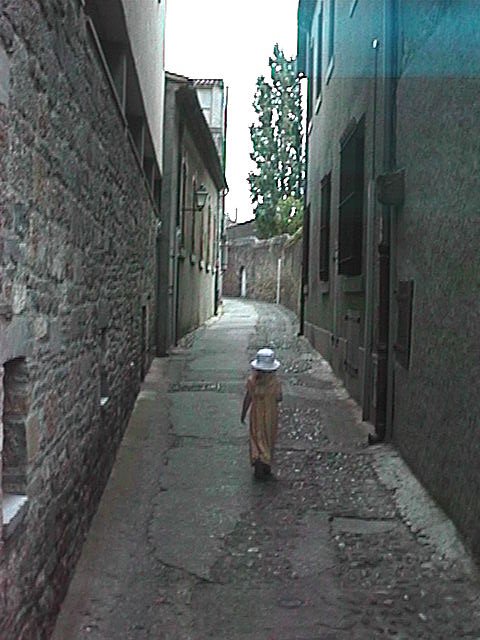
Certain little girl in France. 2000

He doesn’t remember important dates like anniversaries and birthdays.
He doesn’t  like to buy expensive gifts and things that don’t pay.
He doesn’t always think ahead when he starts to speak,
He doesn’t do the romantic, when the practical will serve to treat.

He isn’t always sensitive to my moods and needs,
He isn’t always there for me, or, maybe, that’s just how it seems.
He isn’t always careful, and he can be a dreadful tease,
He isn’t always kind, but he tries to be.

But none of that really matters, because he so good you see,
At all the little things.

He takes me out to walk about and gaze at starlit skies,
He tickles me and makes me laugh until I cry.
He swings our girl out on her swing and tells her lovely tales,
Dances in the living room with her toy dolphins and whales.

He runs down the hall in fear of her monsters there,
and dresses up and drinks her tea – then he makes me swear.
Not to tell a soul and always to conceal,
That he’s just a big old softie when it comes to a certain little girl.

He washes dishes and does laundry when I’m sick and ill,
Cares for me and worries deep and still –
Laughs at my paltry jokes and listens patiently,
As I spout long and loud on things that bore him patently.

It’s the little things you see, that make me love him so,
And I will continue to, as long as stars will glow .
He makes me feel all warm and loved deep inside,
Even though all that mushy stuff makes his face glow bright.

For he feels silly and odd, being romantic and such,
But that doesn’t matter, its for all the little things that I love him so very much.

Changes


I was thinking about Grandmother today. She is in her late nineties.  Nearly one hundred years old. I started listing, in my head, the changes in the world in her life time. She was born, raised, and has lived all her life right here in Oklahoma. When she was a girl, there were no highways, no cars for the farmers and ranchers, no electricity in every home, no indoor plumbing, and no telephones. Laundry was done in vats of water heated over an open fire in the yard, and hung to dry on fences and bushes.  Bread wasn’t made in a bread maker or picked up at the grocery, it was homemade, sweets were a luxury, and the most common form of transportation was one’s feet.
Grandmother has seen the coming of air flight, men walk on the moon, and space exploration. The modern age of medicine that can keep a person alive, almost indefinitely, began in her lifetime.  Today, there are cures for disease that used to wipe out whole generations, and that cure is one dose of medication. Today, there are diseases that were unknown in her days as a mother that can devastate and devour children and adults, and we still have no cure for them.  But, maybe, when we are nearly one hundred years old, there will be.
She had never heard of computers, modems, the internet, or Microsoft, and still thinks computers are toys that just beep and make noise.  Grandmother never played with a Gameboy, skateboard, or had a dolly that talked, drank a bottle, and had to have its nappy changed.  She was doing the work of a full grown woman at the age of 14, not talking on the phone and wondering when her parents were going to understand her.  She was much too busy, cooking, cleaning, working the farm, and looking after her family to worry about such mundane things.  It wasn’t because her parents were mean, it was because everyone had to work together, and work hard, to survive from year to year.
She watched the oil boom and bust here in Oklahoma again and again.  She saw the slow pace of the world around her become faster each generation, until it seemed to spin by so quickly it made her dizzy.  In her day, courting was done on a Friday night, or Sunday afternoon after church, in front of the entire family, and a kiss was a commitment.  Movies were not common, and when they finally came to her town, it was an EVENT to go to a movie.  Smoking was something men did, and if a woman smoked, well, she was fast. After the cultural changes that took place in World War II, grandmother still thought women who smoked were fast, but she learned to adjust like everyone else.  She saw women move from the home to the workplace, first as they needed to support families torn by war, then as the feminist movement dictated.
She once told me that she understood why so many women wanted to work outside the home, after all, the house practically takes care of itself.  Look at all the modern appliances now.  Vacuum cleaners, no more need to move and beat rugs every week; refrigerators, no need to have ice delivered or bottle foods and put them in the cellar; washing machines, no need to spend the day bent over a scrub board and washtub.  Chemicals that clean and scrub all by themselves, air conditioning, and heating that doesn’t require the chopping, hauling, and use of wood to warm the house.  Frozen foods and microwave ovens means that a meal can be prepared in minutes instead of hours. With that much time on their hands, women were bound to want to go to work.
In her life time, she has lived through two world wars, Korea, Viet Nam, and Desert Storm, plus many other warlike crises that involved the United States.  She has seen the advent of equal rights, feminism in its modern form, women in the workforce, commonality of divorce, welfare replace charity organizations, the move from an agro-economic based state to an oil/industrial based state, and cycle of  birth, life, and death repeated over and over.
There are four GENERATIONS of family living who are all directly related to Grandmother.  Each on has gone through the trials of its particular age.  Grandmother gave birth to three boys.  One became a lawyer, one a doctor, one a businessman.  None of them stayed on the farm, and when Grandfather retired, they moved to town too.   Her husband served in World War I, all of her boys served in World War II, and her grandchildren in other serious actions.  Her boys were in the first generation to be in the mobile age, cars became common, and life started to move faster.
Her grandchildren were in the midst of the “revolution” of the turbulent 60’s and 70’s where cultural, social, and family standards were obliterated and rebuilt into something most of us are still trying to figure out.  Her grandchildren were the first to shout about “rights” and experiment with sex, drugs and rock and roll openly.
It is her great grandchildren’s generation who saw the advent of gender issues, openness of alternative lifestyles, lifestyles, by the way, that grandmother still whispers about in vague euphemisms because they embarrass her mightily. Her great grandchildren have taken the word “alternative” and turned it into a an icon for whatever they want to do since there doesn’t seem to be a particular pattern to follow any longer.
Her great great granddaughter is just four years old, but already understands how to use a telephone, computer, and all about money.  She knows the microwave will heat things, and the refrigerator will keep things cold.  She knows more about television and how it works than Grandmother ever will.  She knows more about the world at four than Grandmother did at twenty, or even thirty, because she has been on a jet plane to England, she has gone across the United States in a car, and visited the great monuments to the past. Her world is even more complex than that of the previous generation, and one can only suppose what will come in the future.
Grandmother won’t be with us much longer.  She is a tiny, withdrawn, elderly body that sleeps most of the time.  She needs twenty four hour care, and she will probably never remember my name again.  She deserves her rest, and our deepest respect.  Grandmother has become an icon, a symbol, of all that glued this motley crew together as a family.  She is the last of her generation, the beginning fabric of all of us who live and when she dies, we will begin, slowly, to unravel into separate groups, until all who knew her are gone as well.
It is our progeny, then, who will remember us as we remember her. We will be the old folks who were so odd with their love beads, pot, and wine.  The old folks who wore funny clothes, used archaic communication devices like telephones that plugged in, and the internet.  We will be the ones that our progeny look back on with affection, and, hopefully, respect.  Like Grandmother, we will weave the fabric from whence our family grows.  Will we, like Grandmother’s family, slowly fray and unravel?  Probably, but that is the beauty of it all, because each succeeding generation gets to weave a new pattern based on the history and colours of the last generations. By adding a bit here and a bit therefrom the past, and new colours and patterns from their lives, the fabric lives on and on.  Sure the stitches and weave are different, but the threads of life are all tied together and become stronger as each generation grows.  That’s what family is all about. Grandmother would approve.

Little Girl, Little Girl


Little girl little girl where have you gone?

Yesterday you were a laughing child twinkling eyes filled with laughter, and tumbling curls, flowing after.

In a dress of Pink and white, flowers all around. Baby dolls and little bikes, falling on the ground. Tears, and scrapes, band aids and drinks. Hugs and kisses, our hearts linked.

Little girl, growing up fast, with your girlfriends running past. Trying lipstick, high heels and dresses. Fixing hair, and polishing nails all attitude and tossing tresses.

France

One day the little girl was all gone, and there you stood. A woman grown all on your own. Eyes all aglow, in love with life.

Some times though I see, in your smile and twinkling eyes, that little girl with tumbled curls whose laughter filled the skies

Little girl little girl, where have I gone? “No where, look in your heart Where memories go on, and love never dies. There, your little girl lies.”